
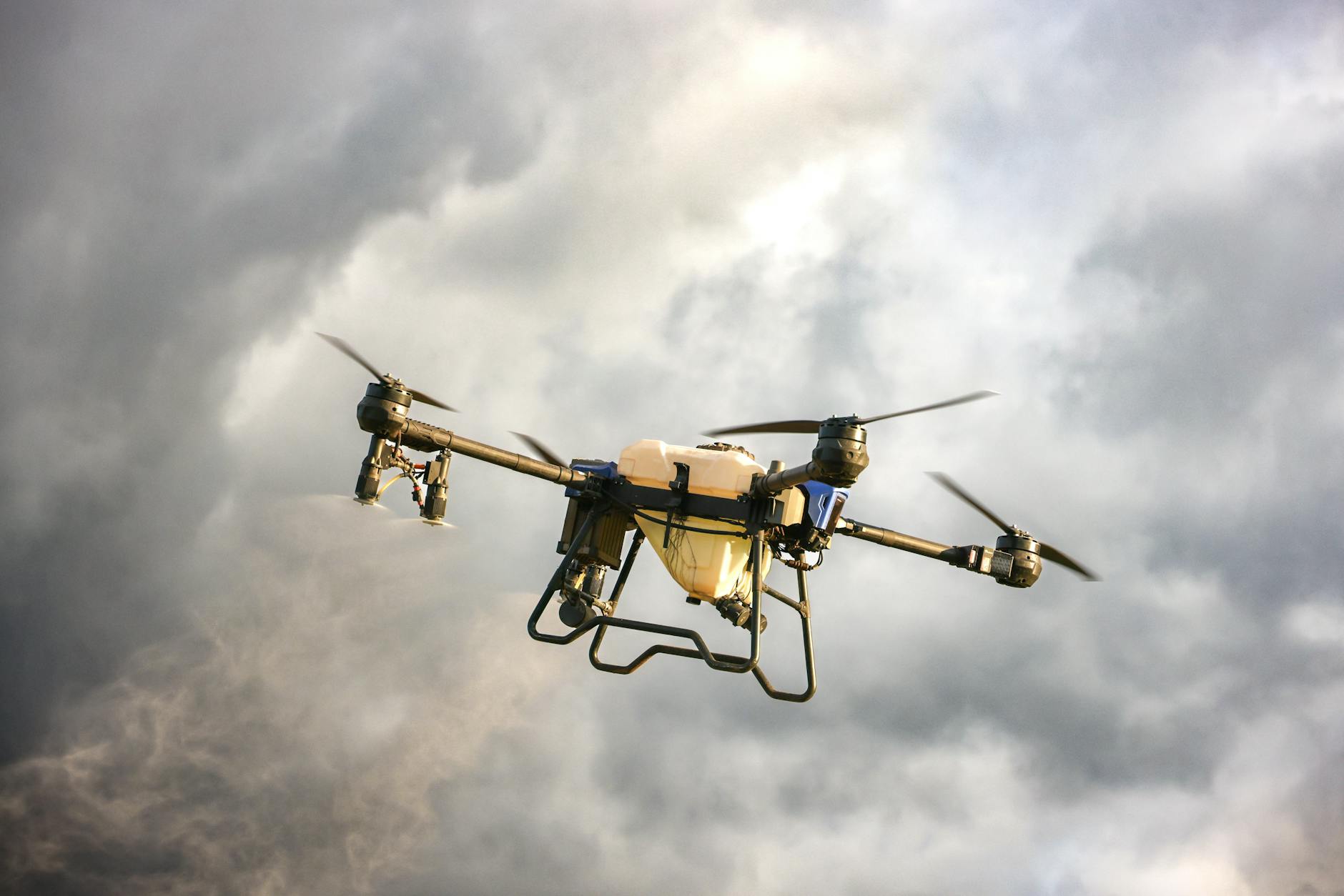
Rural agriculture often faces limited access to precision technology and efficient downstream management, hindering productivity and sustainability. This community service initiative aimed to implement and evaluate a Solar-Autonomous AgroDrone, a solar-powered drone system designed to support automated crop monitoring and downstream agricultural processes in Curahmalang Village, Jember Regency, through the Community Service Program of Universitas Muhammadiyah Jember. While prior studies confirm that drone technology improves precision farming efficiency, integration with renewable energy for rural community empowerment remains underexplored. The program applied a participatory action approach involving 25 farmers and 15 village youths through technical training, field demonstrations, and supervised agricultural monitoring over 12 weeks. Data were collected from crop productivity records, operational cost comparisons, and structured adoption surveys, then analyzed using descriptive and comparative statistics. The findings show a 27% increase in crop monitoring efficiency and a 32% reduction in fuel-related operational costs due to solar energy utilization. Early pest detection responsiveness improved by 45%, and 68% of participating farmers indicated readiness for sustained adoption. No significant technical failures were recorded during implementation. These results support sustainable agriculture theory emphasizing renewable energy integration and digital precision tools for resilient rural development. In conclusion, the Solar-Autonomous AgroDrone enhances automated downstream agricultural practices while strengthening energy-efficient and sustainable farming systems. Its novelty lies in combining solar-powered drone innovation with community-based agricultural empowerment within a structured service-learning framework.
Journal article //
IC Journal of Science, Technology and Society
Solar-Autonomous AgroDrone: Innovation of a Solar-Powered Drone System for Automated Downstream Integration in Precision Agriculture toward Sustainable and Globally Competitive Agricultural Transformation
Vol. 1
No.1
(2026)
Abstract
Full Paper
Cite this
Mahmudi, G. A., Imani, A. B., & Mahmudi, F. A. (2026). Solar-Autonomous AgroDrone: Innovation of a Solar-Powered Drone System for Automated Downstream Integration in Precision Agriculture toward Sustainable and Globally Competitive Agricultural Transformation. IC Journal of Science, Technology and Society, 1(1), 1–10.
References:
-
Afifi, A. A., Arifin, N. A., & Taslapratama, I. (2025). Waste Management in the Circular Economy Framework: A Study on Biomass and Compost Potential Production in Payakumbuh City. Journal of Regional Development and Technology Initiatives, 3(1), 145-160.
Alsharif, M. H., Kim, S., & Kuruoğlu, E. (2023). Renewable energy integration in unmanned aerial vehicle systems: A sustainable approach for smart agriculture. Renewable Energy, 205, 1181–1193. https://doi.org/10.1016/j.renene.2023.01.045
Bappenas. (2023). Indonesia sustainable development report 2023. Ministry of National Development Planning. https://www.bappenas.go.id
Barrett, C. B., Benton, T. G., Cooper, K. A., Fanzo, J., Gandhi, R., Herrero, M., Nelson, R., et al. (2023). Socio-technical pathways to sustainable agriculture. Nature Sustainability, 6(4), 386–395. https://doi.org/10.1038/s41893-023-01085-1
Braun, V., & Clarke, V. (2022). Thematic analysis: A practical guide. Sage. https://us.sagepub.com/en-us/nam/thematic-analysis/book266134
Creswell, J. W., & Poth, C. N. (2022). Qualitative inquiry and research design: Choosing among five approaches (5th ed.). Sage. https://us.sagepub.com/en-us/nam/qualitative-inquiry-and-research-design/book246896
Dedeurwaerdere, T., Hannachi, M., & Terrade, F. (2022). Governing digital transitions in agriculture: Institutional adaptation and sustainability. Journal of Rural Studies, 95, 130–141. https://doi.org/10.1016/j.jrurstud.2022.08.012
Food and Agriculture Organization. (2023). Digital technologies and sustainable food systems. FAO. https://doi.org/10.4060/cc1234en
Geels, F. W. (2023). Digitalization and sustainability transitions in agriculture. Environmental Innovation and Societal Transitions, 46, 100693. https://doi.org/10.1016/j.eist.2023.100693
International Energy Agency. (2022). Renewables 2022: Analysis and forecast to 2027. https://www.iea.org/reports/renewables-2022
International Renewable Energy Agency. (2023). Decentralized renewable energy solutions for rural development. https://www.irena.org
Javaid, M., Haleem, A., Singh, R. P., & Suman, R. (2023). Advancements in precision agriculture using drone and artificial intelligence technologies. Smart Agricultural Technology, 3, 100099. https://doi.org/10.1016/j.atech.2023.100099
Klerkx, L., Jakku, E., & Labarthe, P. (2022). Digitalization of agriculture: Pathways, drivers and governance implications. Agricultural Systems, 196, 103318. https://doi.org/10.1016/j.agsy.2021.103318
Klerkx, L., & Rose, D. (2023). Dealing with the game-changing technologies of Agriculture 4.0: How do we manage diversity and responsibility in food system transition pathways? Global Food Security, 36, 100671. https://doi.org/10.1016/j.gfs.2022.100671
Mahmudi, G. A., Lestari, D. P., & Arianto, D. A. C. (2026). Eco-Green Catalys: An Intelligent Distribution Network for Generative Mycorrhizal Spores Through AI and Iot Optimization for Ecological Complexity Engineering in Post-Deforestation Lands Based on Restorative Bio-Economy Principles. Journal of Regional Development and Technology Initiatives, 4(1), 255-267.
Nowell, L. S., Norris, J. M., White, D. E., & Moules, N. J. (2023). Thematic analysis revisited: Ensuring methodological rigor. International Journal of Qualitative Methods, 22, 1–12. https://doi.org/10.1177/16094069231177307
OECD. (2021). Enhancing rural innovation systems through higher education engagement. OECD Publishing. https://doi.org/10.1787/4d5d5e2f-en
Rejeb, A., Rejeb, K., Simske, S., & Treiblmaier, H. (2022). Drones in agriculture: A systematic review and future research agenda. Computers and Electronics in Agriculture, 198, 107017. https://doi.org/10.1016/j.compag.2022.107017
REN21. (2023). Renewables 2023 global status report. Renewable Energy Policy Network for the 21st Century. https://www.ren21.net/reports/global-status-report/
Rotz, S., Gravely, E., Mosby, I., Duncan, E., Finnis, E., Horgan, M., Fraser, E. D. G., et al. (2022). Automated pastures and the digital divide: Socio-technical sustainability in digital agriculture. Journal of Peasant Studies, 49(3), 620–643. https://doi.org/10.1080/03066150.2021.1986018
Torres-Sánchez, J., López-Granados, F., & Peña, J. M. (2021). An automatic object-based method for optimal thresholding in UAV-based crop monitoring. Remote Sensing, 13(4), 724. https://doi.org/10.3390/rs13040724
World Bank. (2024). Digital agriculture transformation in developing economies. World Bank Publications. https://www.worldbank.org/en/topic/agriculture/publication/digital-agriculture-transformation